jamal
jamal 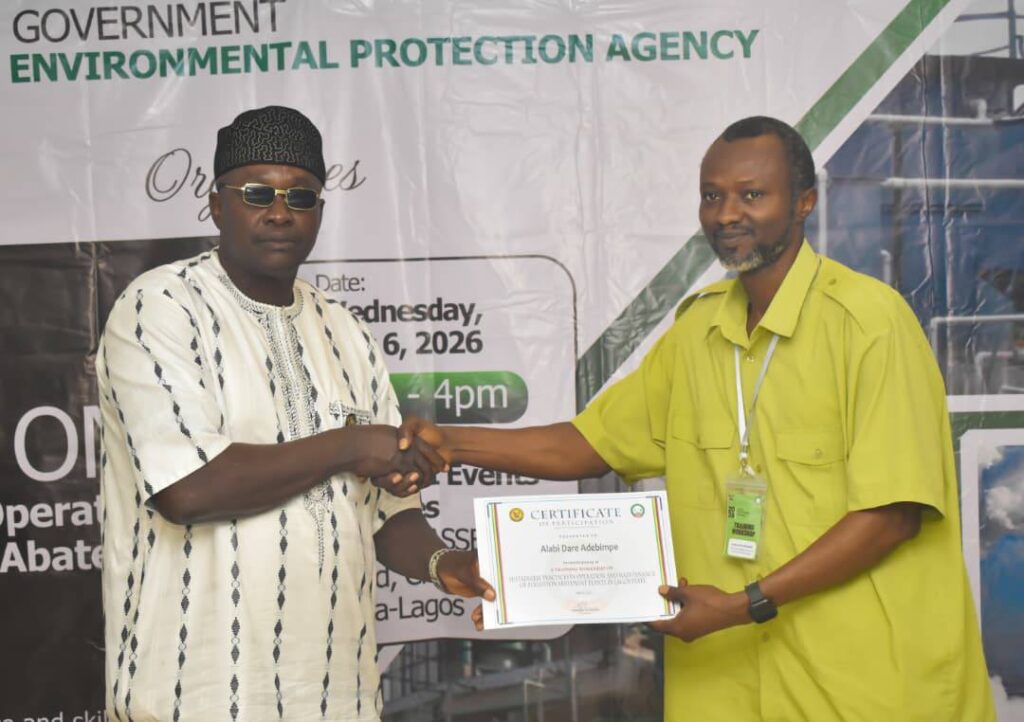
BY AMUDA GBEMISOLA EUNICE
The Lagos State Environmental Protection Agency (LASEPA) has organised a training workshop focused on sustainable practices in the operation and maintenance of pollution abatement plants across Lagos.
Speaking at the event held recently at the Assbifi Events & Suites, Alausa, lkeja, Lagos, the Special Adviser to the Governor on Environment, Engr. Olakunle Rotimi Akodu described the training as a vital tool for strengthening pollution management across industries in the state.
He explained that the annual programme serves as a measure to assess compliance levels, recognise operators who meet regulatory standards, and identify those requiring training particularly in effluent and industrial waste management.
According to him, sharing this data with facilities encourages self-regulation and improved compliance, adding that sustained efforts are gradually improving environmental performance statewide.
In his remarks, the Permanent Secretary, Office of Environmental Services (OES), Dr. Omobolaji Tajudeen Gaji emphasised the importance of sustainable practices in pollution abatement operations.
Dr. Gaji, who was represented by the Deputy Director of the Environmental Assessment Department, Mr. Adeniran Ademola, stressed that health and safety, alongside strict quality control, must remain central to the programme.
He underscored the need for continuous training to address evolving industry demands, advocating the engagement of experienced resource persons and the adoption of advanced technologies.
Similarly, the Permanent Secretary, Office of Drainage Services (ODS), Engr. Mamud Adegbite commended LASEPA for convening a timely and impactful workshop.
Engr, Adegbite, who was represented by the Director of the Water Resources Department, Engr. Oyedele James, noted that efficient management of pollution abatement facilities is essential for protecting public health and preserving environmental integrity.
The General Manager of LASEPA, Dr. Babatunde Ajayi, highlighted the growing importance of adopting modern technologies, such as scrubbers and AI-enabled monitoring systems to track emissions and enhance environmental performance. He noted that consistent monitoring and enforcement have yielded measurable progress, with compliance levels improving significantly in recent years.
Dr. Ajayi revealed that many industries have begun installing pollution control systems, resulting in reduced emissions as confirmed by monitoring data. He emphasised that enforcement remains critical, noting that non-compliant operators face sanctions including fines, shutdowns, and legal prosecution.
The Head of the Legal Unit, LASEPA, Ms. Temitope Kayode, outlined the agency’s enforcement mechanisms, emphasising adherence to established laws, standards, and due process.
She encouraged participants to apply the knowledge gained to improve their operation and maintenance of the ETPs for a better and pollution-free environment in the State.
The highlight of the event was the presentation of a certificate of participation to the registered participants.