Obasa’s Agege Political Dynasty Deteriorating As Sins of Close Associates Resurface to Haunt Lagos Speaker
 jamal
BY ABDULSAHEED AKINOLA
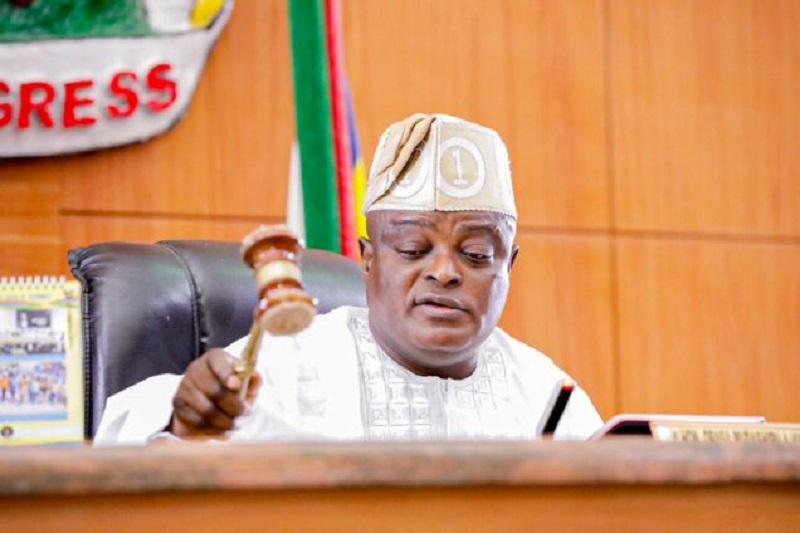
The shift of two key politicians linked to Mudashiru Obasa, the Speaker of the Lagos State House of Assembly, from the All Progressives Congress (APC) to the Allied Peoples Movement (APM) has sparked renewed scrutiny regarding political affiliations in Agege in anticipation of the upcoming 2027 general elections.
Several misdeeds committed by some of his close associates have become a weapon for his political rivals within the ruling APC and opposition factions in his support base in Agege. The political scene in Agege, Lagos State, is experiencing a notable change following the departure of Ganiyu Kola Egunjobi, the recent Chairman of Agege Local Government, and Azeez Oladapo Yusuf, known as Ninolowo, from the APC to join the APM.
These two politicians, who were reportedly connected to the political faction of the Lagos State House Speaker, Mudashiru Obasa, secured APM nominations to vie for the Agege Constituencies I and II seats in the Lagos State House of Assembly in preparation for the 2027 elections.
Their choice to depart from the APC was influenced by disagreements regarding the party’s primary elections, where various candidates were acknowledged for the two constituencies.
Egunjobi and Yusuf were initially believed to have won the APC primaries, but the party later recognized Gbenga Abiola for Agege Constituency I and Sakiru Enimakure for Constituency II.
Unhappy with the revised results, Egunjobi contested the updated announcements, asserting that the declared candidates did not represent the actual voting results from the various polling stations.
This conflict ultimately led to their exit from the ruling party, resulting in their affiliation with the APM.
The Lagos APC subsequently expelled both individuals, charging them with anti-party behavior and disloyalty for obtaining nominations from a different political entity.
Nevertheless, the defectors refuted claims that Obasa orchestrated their exit from the APC, affirming that their decision was made independently as a response to what they perceived to be unfairness within the party’s primary election procedure.
Despite their clarifications, this situation has highlighted the political ramifications for Obasa, whose sway in Agege has persistently influenced Lagos politics.
Reports suggest that the Speaker had backed Egunjobi and Yusuf during an Agege stakeholders’ gathering in May, coinciding with his announcement to run for the Agege Federal Constituency seat in the House of Representatives.
Obasa has since secured the APC nomination for the federal constituency, setting the stage for his transition from the Lagos Assembly to the National Assembly.
The exit of two politicians openly identified with his political faction has thus added a new layer to the political dynamics leading up to the 2027 elections.
This recent occurrence unfolds amid Obasa’s ongoing political struggles, particularly the leadership turmoil that affected the Lagos State House of Assembly in January 2025.
Obasa was ousted from his position as Speaker by Assembly members and succeeded by Mojisola Meranda, an event that ignited a lengthy political and institutional turmoil.
He later contested his dismissal in court, and in April 2025, the Lagos State High Court deemed the removal process illegal, unconstitutional, and ineffective, also invalidating the actions that led to his ousting.
Obasa ultimately resumed his role as Speaker, effectively concluding the dispute over leadership.
This incident reawakened interest in the political landscape concerning the Speaker and the clashing interests within the Lagos political sphere.
As he gears up for a federal legislative race, the situation in Agege poses a new challenge, especially regarding the unity of his political connections.
Despite the defections raising doubts about the durability of Obasa’s political framework, some interpret this as a sign of its disintegration.
The two politicians involved have asserted that their choice was influenced by disagreements related to the APC nomination process and was not compelled by Obasa.
Equally, certain APC influencers in Agege have reportedly shrugged off worries regarding the effects of the defections, committing to rally support for the party’s endorsed candidates.
However, a significant concern for some is what a few referred to as a backlash involving one of Obasa’s close associates, Chief Akinropo, who was allegedly connected to the murder of a young man in 2023, when he was implicated in the brutal killing of an emerging politician. The young man’s death was a setback for Obasa’s group, with supporters still grappling with the repercussions of the incident, which Akinropo denied. However, an exclusive investigation by P.M EXPRESS, a Lagos-based newspaper, later uncovered and exposed the truth behind the circumstances of the young man’s tragic demise, which was tied to Obasa’s associate.
When members of the Lagos State House of Assembly voted to impeach Mudashiru Obasa on January 13, 2025, several media outlets and fellow lawmakers highlighted various accusations of misconduct, leadership conflicts, and financial issues. He subsequently returned to the speakership in March 2025 following a political turnaround and a High Court ruling that invalidated his dismissal.
Reports from sources like New Dawn newspaper, City Express News, and The Sun Nigeria indicated that lawmakers initiating the impeachment motion charged Obasa with serious misconduct under Section 92(2)(c) of the Constitution, citing: Chronic tardiness to legislative sessions and gatherings, authoritarian behavior, disregard for fellow lawmakers, and the intimidation or incitement of other legislators.
An ongoing ban that kept journalists from reporting on Assembly activities alongside former Clerk Olalekan Onafeko, allegation of mismanagement involving supposed expenditures of ₦17 billion on Assembly fencing.
Reports from investigations and whistleblowers claimed that Obasa managed numerous bank accounts associated with his BVN to misappropriate public money. The Economic and Financial Crimes Commission (EFCC) called him in for inquiry, but no official charges were filed, and later documents indicated that a money laundering case was withdrawn.
He encountered backlash from the public following his description of EndSARS demonstrators as “miscreants.”
Analysts and commentators highlighted discord with Governor Babajide Sanwo-Olu, noting issues such as delays in cabinet nominee approvals and budget discussions, alongside conflicts with senior party members and gubernatorial aspirations.
For the APC, the pressing issue is to handle the disputes stemming from the primaries while ensuring unity within the party throughout the constituency.
For Obasa, the emerging developments pose significant questions regarding the capability of his political associates to stay cohesive when personal ambitions conflict with party goals.
As he aims to transition his political career from the Lagos Assembly to the National Assembly, the ability to nurture relationships and juggle conflicting interests within his political base will be a crucial element of the ongoing political dialogue.
Whether the recent departures signify merely a singular dispute regarding party nominations or indicate the onset of a larger political shift in Agege remains uncertain.
What is clear is that Agege is entering a new chapter of political maneuvering, with the 2027 elections likely to sharpen the focus on the various competing interests, alliances, and loyalties present in its political arena.